
Shared Parental Leave: Sharing or splitting up leave
Shared Parental Leave (SPL) gives parents greater flexibility in how they care for their child. SPL allows birth mothers to share a portion of maternity leave and pay with their partners to care for children from birth until their first birthday. SPL can also be used by the birth mother alone to allow her to return to work for periods in between periods of SPL, this flexibility does not exist with Maternity Leave. SPL can also be used by parents who are adopting or having a baby through surrogacy.
This article provides guidance on how to share and split up Shared Parental Leave (SPL) and Pay (ShPP). For more information, see our other articles on Shared Parental Leave: Overview and eligibility for leave.
Note: The provisions for adopters and parents of a child born through surrogacy are very similar so for simplicity we only refer in this article to parents (birth parent and partner), which includes same-sex couples. For more information, see our article on Shared Parental Leave for parents using adoption or surrogacy.
How much leave can be shared?
The first 2 weeks of maternity and adoption leave are compulsory for the birth mother for health and safety reasons (4 weeks if they work in a factory). Eligible parents can therefore take up to 50 (or 48) weeks as Shared Parental Leave (SPL), and up to 37 weeks of Shared Parental Pay (ShPP).
How much SPL or ShPP eligible parents can take depends on how much leave the birth parent has taken.
A common error which we hear about on our Helpline is that people are told by their employer/HR, or even other advisors, that both parents cannot be off and being paid at the same time.
That’s not correct advice for the statutory scheme.
You can take SPL at a different time from your partner/other parent, or at the same time. For example, a woman can be on maternity leave and her partner can be on SPL at the same time. It is also possible for just one parent to take SPL. There is no requirement for both parents to take SPL and indeed, only one parent may qualify to take SPL.
How shared leave may be taken
How and when leave and pay are shared is up to the parents, as long as the leave is taken within the first year after birth of the child and as long as the regulations are followed.
So – to summarise – both partners can be off together, e.g. on maternity leave and SPL at the same time (both being paid), or at different times, e.g. one after the other or just one parent can take SPL.
For information on eligibility if circumstances change or if the birth parent is not entitled to maternity leave see our page on eligibility here.
If you have any questions about this, please call our advice helpline.
How to ‘create’ Shared Parental Leave
Shared Parental Leave is created when the birth partner ends (‘curtails’) her maternity leave, to create an amount of leave available to her partner to take as SPL and ShPP.
If the birth parent is not entitled to maternity leave (for instance, she is a worker or is self-employed), she can create SPL by ending her Maternity Allowance early. In practice the notice must be given on or before the 38th week, in order to create SPL for her partner. Should she fail to do so, she will not be able to create SPL or ShPP for her partner. The number of weeks of Maternity Allowance taken must be deducted from 52 weeks to calculate the number of weeks of SPL that will be available for her partner to take.
The first two weeks of maternity leave are compulsory, so partners can share or split up to 50 weeks of leave, as pictured below.

How to ‘create’ Shared Parental Pay
Shared Parental Pay (ShPP) is also created when the birth partner ends (‘curtails’) her maternity leave and/or maternity pay, to create an amount of leave available to her partner to take as SPL and ShPP.
Please note that as Statutory Maternity Pay (SMP) is paid at the higher rate of 90% of the mother’s average earnings for the first 6 weeks whereas Shared Parental Pay is only paid at the statutory rate, the mother will generally be better off staying on maternity leave for at least the first 6 weeks.
The first two weeks of maternity pay are compulsory, so partners can share or split up to 37 weeks of pay, as pictured below.
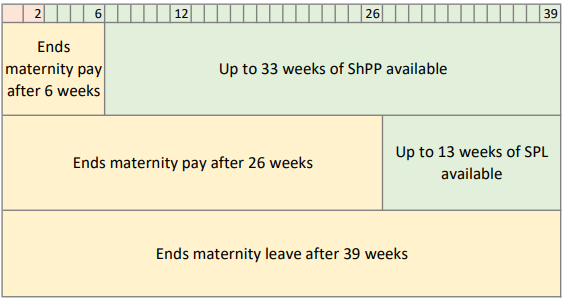
How leave can be shared
SPL can be taken in any way eligible parents would like, as long as leave is taken within the first year of birth (or adoption) and it is within the rules of the scheme.
For instance:
- Both parents can use SPL to stay off work at the same time
- Both parents can use SPL and stay off work at different times
- The birth parent can return to work early and take SPL at a later date
- The birth parent can return to work early and her partner can take SPL
- The birth parent can curtail their maternity leave in order to create SPL to allow them to return to work for periods in between periods of SPL . There is no requirement for both parents to take SPL.
The non-birth partner can start their SPL as soon as the child has been born and while the birth parent is still on maternity leave, as long as the birth parent has committed to end her leave early (by serving a notice of curtailment on her employer or on Jobcentre Plus if she is receiving Maternity Allowance).
Non-birth partners can take paternity leave (if eligible) in addition to SPL. Both paternity leave and SPL can only be taken after the birth and must be taken within 52 weeks of the birth. From 6 April 2026, SPL can be taken before or after paternity leave.
For more information on how to book SPL, see our article on notice and booking.
Examples of sharing leave
This section explains some common examples of how partners can share leave.
Example 1: Birth mother returns to work after 39 weeks and shares unpaid leave with partner
This is a common way for partners to share leave. The birth partner takes 39 weeks of leave with pay, and chooses to return to work once the paid portion of maternity leave ends.
If she curtails her maternity leave by 13 weeks, she has up to 13 weeks that she can share with her partner. Her partner can take this leave whenever they would like (within the 52 week period after birth) – they can, in this example, take SPL after their paternity leave (as they have chosen to take paternity leave right away), or after their partner returns to work.

Example 2: Partners want to share leave equally
This is also a common way for partners to choose to share leave. The birth partner commits to end her maternity leave and pay after 26 weeks, to create an entitlement to 26 weeks of leave and 13 weeks of pay for her partner to take.
Her partner can take this leave at the same time, or after the birth mother returns to work.

Example 3: Partner wants to take leave in ‘blocks’
This is also a common way for partners to choose to share leave. The partners want to share leave equally, and the birth mother ends her maternity leave and pay after 26 weeks, but her partner takes their entitlement in two blocks.
In this example, the partner has taken 13 weeks of SPL and ShPP after paternity leave, and a second block of 13 weeks of unpaid SPL after the birth mother returns to work.

Things to consider when deciding how to share leave
- Do you want to share the caring of your child with your partner in the first year?
- Do you want time off together or separately?
- Do you want to take leave all at once, or in blocks throughout the year, returning to work in between?
- Do you or your partner need to work during the first year for financial reasons?
- Are you are entitled to enhanced maternity pay or is your partner entitled to enhanced parental pay?
- As SMP is paid at the higher rate of 90% of the mother’s average earnings for the first 6 weeks whereas Shared Parental Pay is only paid at the statutory rate, the mother will generally be better off staying on maternity leave for at least the first 6 weeks.
Some advantages of taking SPL include:
- It can be shared between partners, allowing them to stay off work at the same time or at different times
- You can return to work, and go back on leave (unlike maternity leave, which cannot be restarted once ended)
- It can be taken in up to three ‘blocks’ (or more if your employer agrees)
- Employees on SPL can work up to 20 ‘SPLIT’, whereas those on maternity leave can only work up to 10 ‘KIT’ days
- An employee can use SPL to take paid holiday during their leave period, to boost their pay while they are off work

This advice applies in England, Wales and Scotland. If you live in another part of the UK, the law may differ. If you are in Northern Ireland you can visit the Labour Relations Agency or call their helpline Workplace Information Service on 03300 555 300.
Our helpline and online contact form is now closed as we wind down our operations. Our free legal advice pages remain available and up to date until further notice. You can find a list of trusted organisations that may be able to help you below.
| Organisation and link to website | Area of Advice | Telephone |
|---|---|---|
| Employment Rights | ||
| ACAS | Acas gives employees and employers free, impartial advice on workplace rights, rules and best practice. We also offer training and help to resolve disputes. | 0300 123 1100 |
| Citizens Advice (England & Wales) | Citizens Advice is a charity which provides free, confidential, and independent advice on employment, legal, financial, housing, and consumer problems | 0808 223 1133 |
| Citizens Advice (Scotland) | Citizens Advice is a charity which provides free, confidential, and independent advice on employment, legal, financial, housing, and consumer problems | 0800 028 1456 |
| Maternity Action | Maternity and Parental Rights at Work and Benefits for Families & NHS charges for maternity care | 0808 801 0488 |
| Pregnant Then Screwed | HR Advice Line – for questions on employment rights, flexible working, parental leave or workplace discrimination | 0300 222 5799 |
| Equality Advisory and Support Service (EASS) | The helpline advises and assists individuals on issues relating to equality and human rights, across England, Scotland and Wales. | 0808 800 0082 |
| Trade Union | If you are a union member, contact your union for support. If not, you may wish to join, but check whether support is available for existing issues. | |
| Health and Safety Executive (HSE) | Guidance on workplace health and safety rights and accepts reports of serious workplace health and safety concerns. | |
| Advicenow | Provides free legal information, guides, self-help tools and training to help people deal with legal issues and understand their rights. | |
| Protect | Provides advice and support to people raising concerns about whistleblowing | 020 3117 2520 |
| Zero Hours Justice | Offers information and support on the rights of workers on zero-hours and insecure contracts | 01904 900 151 |
| Legal Advice and Representation | ||
| Law Centres Network | Law Centres work within their communities to defend the legal rights of local people. You can use their website to find your local Law Centre. | |
| LawWorks | The LawWorks Clinics Network provides free initial advice to individuals on various areas of law including employment law, social welfare law, housing matters, consumer disputes, debt and welfare rights. | |
| Advocate | Advocate is a charity that finds free legal assistance from volunteer barristers | |
| South West London Law Centres | Provides free, independent legal advice to people who cannot afford a lawyer, including advice on employment, housing, debt, immigration issues. | 020 8767 2777 |
| Employment Tribunal Litigants in Person Support Scheme (ELIPS) | ELIPS provides pro bono assistance to unrepresented litigants. It currently covers London Central, Cardiff, Bristol, Midlands (West), Newcastle, Leeds and Manchester Employment Tribunals. | |
| Legal Aid Check your eligibility for Legal Aid online | Legal Aid funding is only available for employment cases involving discrimination. | |
| YESS Law | Employment law advice and support, including settlement agreements. Yess Law do not represent clients in Employment Tribunal Proceedings | 020 3701 7530 |
| The Free Representation Unit (FRU) | The Free Representation Unit (FRU) is a charity that provides legal advice, case preparation and advocacy in employment & social security tribunal cases if you have a hearing date at a tribunal in London and the South East and your case is referred by a referral agency | |
| Employment Tribunal Customer Contact Centre | Provides information about the Employment Tribunal process but does not offer legal advice. | 0300 123 1024 |
| Appoint a solicitor The Law Society provides information on finding a solicitor. | If you are able to afford to do this, you can instruct a solicitor who is an expert in maternity and family friendly rights. A good solicitor will give you honest advice about the strengths and weaknesses of your case, the likely costs and s/he should try to resolve your case as soon as possible and so keep the costs you have to pay to a minimum. | |
| Disability Law Service | Provide free legal advice on community care, employment, housing, discrimination, public law and welfare benefits to disabled people and their carers | 0207 791 9800 |
| Child Law Advice | Provided by Coram Children’s Legal Centre, advice for Litigants in person | |
| Rights of Women | Women’s voluntary organisation committed to informing, educating and empowering women concerning their legal rights | 020 7251 6577 |
| Benefits and Financial Support | ||
| Citizens Advice (England & Wales) | Citizens Advice is a charity which provides free, confidential, and independent advice on employment, legal, financial, housing, and consumer problems | 0808 223 1133 |
| Citizens Advice (Scotland) | Citizens Advice is a charity which provides free, confidential, and independent advice on employment, legal, financial, housing, and consumer problems | 0800 028 1456 |
| Advice Local | Your local guide to help with employment and work issues, benefits, money, housing problems and more | |
| Age UK | Provide free, confidential advice, practical support, and companionship | 0800 678 1602 |
| Carer’s UK | Provide advice on benefits, rights, and emotional and peer support. | 0808 808 7777 |
| Scope | Offers information, advice and support for disabled people and their families, including guidance on benefits, work and independent living. | 0808 800 3333 |
| NRPF Network | Provides guidance and resources on no recourse to public funds (NRPF) and support options for people affected by immigration-related benefit restrictions. | 0800 169 0283 |
| Maternity Allowance helpline (DWP) | Maternity Allowance is a government benefit for pregnant women or new mothers who do not qualify for Statutory Maternity Pay (SMP) from their employer. | |
| HMRC Statutory Payment Dispute Team | Resolves disputes about entitlement to statutory payments, including maternity, paternity, adoption, shared parental, parental bereavement and neonatal care pay. | |
| Pregnancy, Maternity and Baby Support | ||
| Maternity Action | Maternity and Parental Rights at Work and Benefits for Families & NHS charges for maternity care | 0808 801 0488 |
| Tommy’s | Provide advice and support to parents-to-be, expectant parents, and families who have experienced baby loss | 0800 0147 800 |
| Bliss | Support and information for families of premature and sick babies, including emotional support, neonatal care guidance | |
| Twins Trust | Offers support, information and peer support for families with twins, triplets and multiple births | 0800 138 0509 |
| Sands | Sands works to support anyone affected by the death of a baby | 0808 164 3332 |
| Best Start in Life | Advice and support for your child’s development | |
| Mental Health and Wellbeing | ||
| Mind | Mind empower individuals experiencing mental health problems through advice and support | 0300 102 1234 |
| Maternal Mental Health Alliance | Charity and network of 160 organisations, dedicated to ensuring women and birthing people affected by perinatal mental health problems have access to high-quality, compassionate care | |
| Pandas | Pandas offer hope, empathy and support for every parent, carer or network affected by Perinatal Mental Illness | |
| Samaritans | Provide emotional support to anyone in distress, struggling to cope, or at risk of suicide | 116 123 |
| Domestic Abuse | ||
| Women’s Aid | Offers support, information and signposting for women and children experiencing domestic abuse | |
| Support for single parent families | ||
| Gingerbread | Offers advice and information support for single parents on work, benefits, finances and family issues. | |
| One Parent Families Scotland | Provides advice and support to single parents in Scotland including benefits, money and health and wellbeing. | 0808 801 0323 |
| Disability | ||
| Contact | For families with disabled children | 0808 808 3555 |
| Carer’s support | ||
| Carer’s UK | Provide advice on benefits, rights, and emotional and peer support. | 0808 808 7777 |
| Childcare | ||
| Childcare Service Helpline | Contact HMRC if you need help applying for Tax-Free Childcare, applying for free childcare if you’re working or using your online childcare account. | 0300 123 4097 |
| Best Start | Provide information on all available childcare support | |
| Coram – Family Information Service | Provide a tool to search for contact details for your local Family Information Service who can provide advice and support on childcare in your area |
The information on the law contained on this site is provided free of charge and does not, and is not intended to, amount to legal advice to any person on a specific case or matter. If you are not a solicitor, you are advised to obtain specific legal advice about your case or matter and not to rely solely on this information. Law and guidance is changing regularly in this area.
We cannot provide advice on employment rights in Northern Ireland as the law is different. You can visit the Labour Relations Agency or call their helpline Workplace Information Service on 03300 555 300.